T8 Diy 3-axis Cnc Milling Machine W/arduino and Grbl Review
News The Projection Engineering science RoboSpatium Contribute Subject index Download Responses Games Shopping tips Contact
<<< CNC v3.2.2 Next3D >>>
CNC engraver T8
The video nigh CNC engraver T8
Get this machine on Gearbest.
Clarification
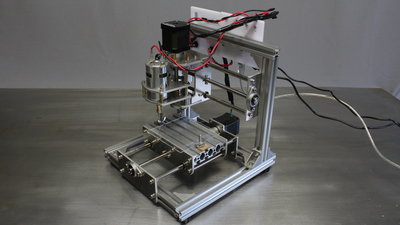
I got this CNC automobile blazon T8 from the online store Gearbest. The CNC is sold equally engraving machine, simply because the mechanics is too weak to residuum side load every bit occuring while carving wood or plastics with a milling bit.
The machine is slap-up to learn or teach base noesis about Estimator Aided Manufacturing (CAM). With the low price yous don't burn down much money when breaking a part because of an operating error (something that will happen sooner or later). There is a lot to learn and and then a lot that can become incorrect in the software concatenation from your 3D CAD model to the auto commands. It'southward a practiced device to run across how things work in full general.
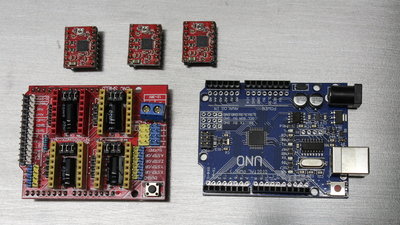
All 3 axes are driven by bipolar stepper motors through spindles. The electronic board is an Arduino Uno clone with a CNC shield. The firmware running on the microcontroller is grbl, thus the machine can process G-lawmaking.
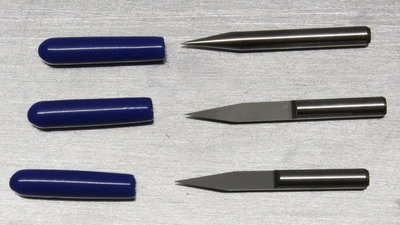
The motorcar comes with 3 10 degree V bits, enabling you to engrave wood or plastics up to 3mm deep.
The shaft diameter is three.175mm or one/viii inch and the tool holder on the spindle motor is for that diameter simply.
Build instruction
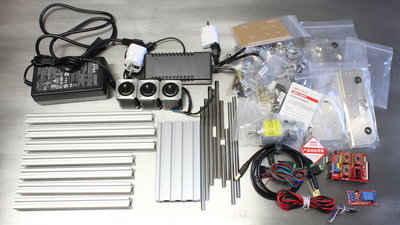
The T8 comes every bit a kit, but with no documentation. To brand things like shooting fish in a barrel for you lot, here comes my version...
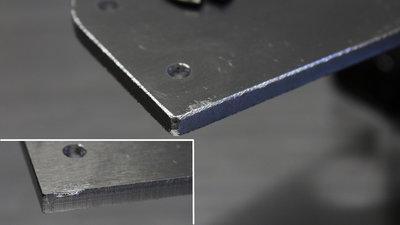
The parts come up with scratches, but none of them affects the functionality. Grind all sharp edges of the parts with a file - you lot won't go encarmine fingers during assembly or performance of the automobile.
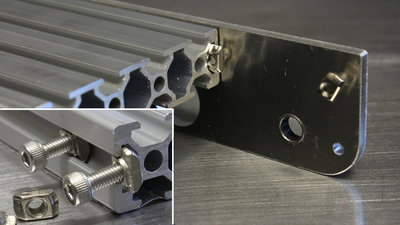
Special nuts with hexagon screws are used to mount parts on the aluminium profiles. Hexagon tools are part of the kit.
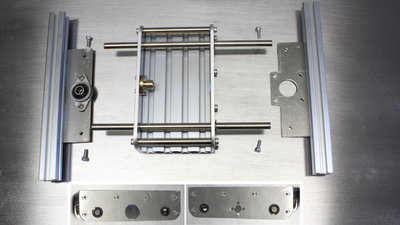
Use the round bars with the smaller diameter for the CNC table.
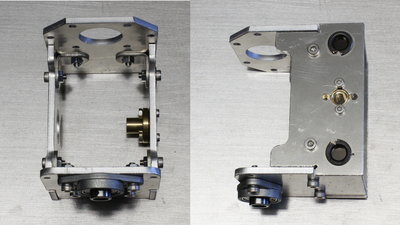
Don't assemble the X carriage mirror inverted. The brass lead nut must exist on the right side when looking at the forepart, the ball bearing is on the bottom.
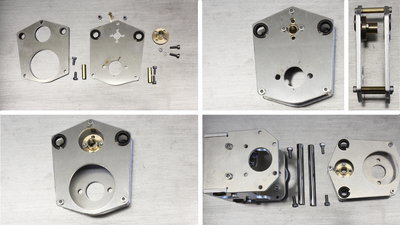
Z carriage.
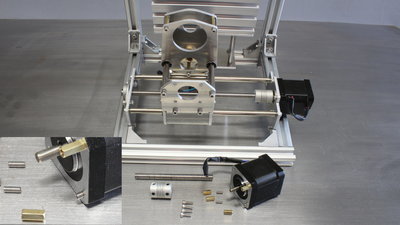
The stepper motor of the Z axis is mounted with spacer nuts.
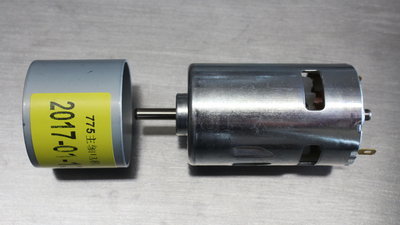
the iron ring on the spindle motor must be removed.
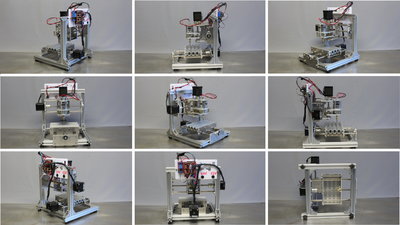
9 views on the assembled auto.
Electronics
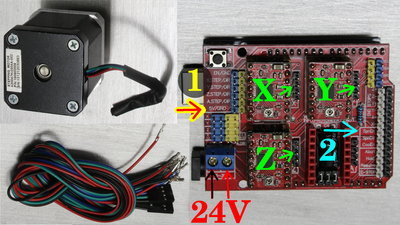
An Arduino Uno clone with a CNC shield (Version three.00) on summit is used to command the motors.
As demonstrated in the video, cables with apartment plugs must be soldered on the stepper motors. Plug the motors on the CNC shield likewise the A4988 driver chips (X, Y, Z).
The female plug of the 24V power supply is too connected to the CNC shield. Note the correct polarity!
The pins maked by (1) on the photo run to the relay and provide 5V supply voltage. Notation the correct polarity! the left (blueish) pin has +5V, the right (yellow) pin is ground.
The control pin of the relay must be pluged to the "Spindle Enable" (SpnEn) pivot (2).
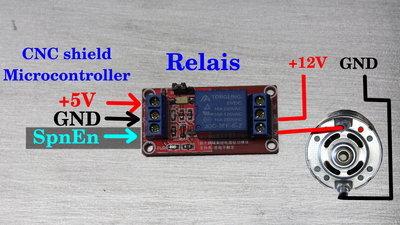
The spindle motor is turned on or off through a relay.
Connect the left terminals with the accordant pins on the CNC shield (see figure above).
The spindle motor is connected to the relay and the relay in turn is connected to the +12V pivot of the female plug of the accordant power supply. Ground of the female person plug is continued to ground of the spindle motor.
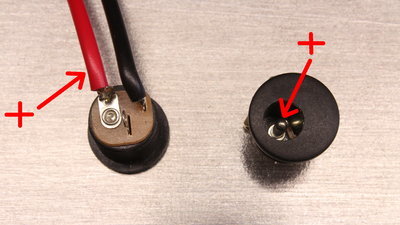
Note the correct polarity!
The anode (plus, use red cable) must be continued to the cardinal pin! Check the allocation of the soldering tag on dorsum of the plug with a multimeter.
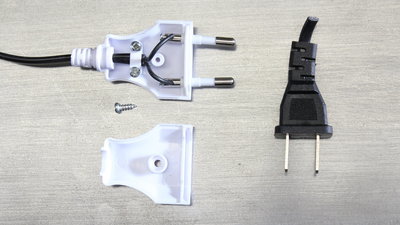
The adapters of the mains cables are a weak betoken of the kit. The plug of the 24V power supply tin easily be replaced by a normal cable. I cut the cable of the 12V power supply to connect a new plug. Use a switchable multi plug to have an emergency cease function for your motorcar.
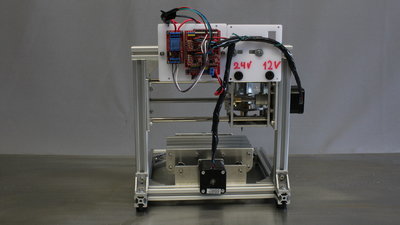
The electronic components are mounted on back of the machine.
Software
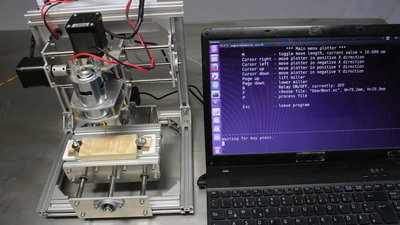
I wrote a tiny plan, enabling keyboard command and sending G code files. The software runs in a Linux Final.
The X axis must move to the correct when pressing the right cursor fundamental. If not, remove the plug of the 10 motor on the CNC shield and replug in 180 degree position.
The CNC table must move to the front when pressing the cursor up cardinal (spindle motor moves backwards in relation to the table). If not, replug the Y motor on the CNC shield in 180 degree position.
The spindle motor must move up when pressing the page upward fundamental. If non, replug the Z motor in 180 caste position.
You can get the (experimental) software I used in the video in the column Download.
Firmware
My T8 came with grbl v0.9 installed. The default values are: Grbl 0.9g ['$' for help]
$0=x (pace pulse, usec)
$1=25 (step idle delay, msec)
$two=0 (step port invert mask:00000000)
$three=half-dozen (dir port capsize mask:00000110)
$4=0 (step enable invert, bool)
$v=0 (limit pins capsize, bool)
$six=0 (probe pin capsize, bool)
$10=3 (status report mask:00000011)
$11=0.020 (junction deviation, mm)
$12=0.002 (arc tolerance, mm)
$13=0 (report inches, bool)
$14=1 (auto showtime, bool)
$20=0 (soft limits, bool)
$21=0 (hard limits, bool)
$22=0 (homing wheel, bool)
$23=0 (homing dir invert mask:00000000)
$24=25.000 (homing feed, mm/min)
$25=500.000 (homing seek, mm/min)
$26=250 (homing debounce, msec)
$27=1.000 (homing pull-off, mm)
$100=800.000 (x, step/mm)
$101=800.000 (y, step/mm)
$102=800.000 (z, step/mm)
$110=400.000 (x max charge per unit, mm/min)
$111=400.000 (y max rate, mm/min)
$112=400.000 (z max charge per unit, mm/min)
$120=200.000 (ten accel, mm/sec^2)
$121=200.000 (y accel, mm/sec^2)
$122=200.000 (z accel, mm/sec^2)
$130=200.000 (x max travel, mm)
$131=200.000 (y max travel, mm)
$132=200.000 (z max travel, mm)
Examples
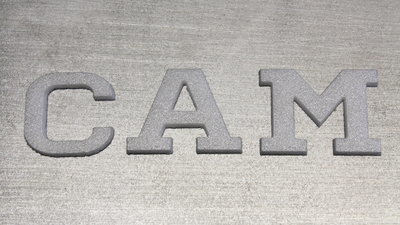
3mm Depron, characters height 28mm:
3mm Depron is cheap and piece of cake to cut, thus it is a expert material to offset your experiments with this CNC.
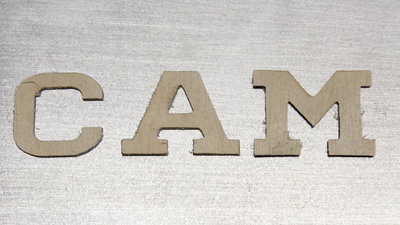
1mm plywood, characters height 28mm:
Feedrate: 80mm per infinitesimal
Depth per pass: 0.3mm
1mm plywood tin be cutting with ease.
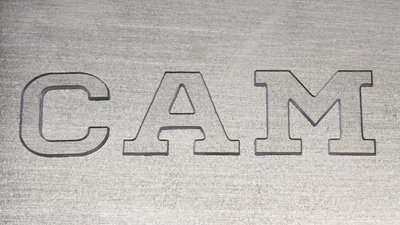
2mm Acrylic plastics, Characters height 28mm:
Feedrate: 80mm per minute
Depth per pass: 0.2mm
Fifty-fifty the Acrylic plastics tin ba cut with the machine. Caused past the V bit, the cut edges are not perpendicular - the engraving machine with that tool is non meant to be used as router merely it works in general.

Engravinf wood (30x80mm):
Feedrate: 80mm pro Minute
Depth per laissez passer: 0.3mm
Total depth of the engraving i.2mm
The total depth of the engraving is 1.2mm. The engraving is clearly visible, but caused by the fiber construction of wood, the edges are a bit crude, thus to get a perfect result you must use some sandpaper to smoothen the surface.
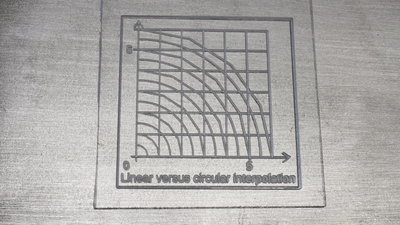
Engraving acrylic plastics:
Line depth 1mm with 0.2mm per run, feedrate 80mm/min.
The characters are 5mm high and conspicuously legible.
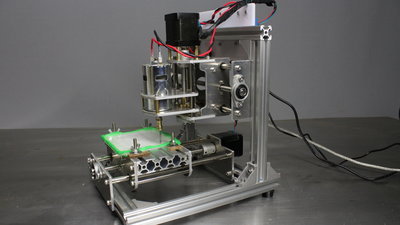
Plastics is a tricky textile to procedure with a CNC machine. If the milling bit moves to boring along the path, the plastics starts melting by what the miller can no longer cut the material. In dissimilarity with a also high feedrate, the V scrap can't cut the plastics fast plenty because of the low revolution speed of the milling motor - your milling bit will crevice. With some water you can absurd down the plastics and so avoid it from melting at the low feedrate of 80mm per minute used here. With pure h2o as coolant you can process the plastics even with this low power automobile.
Here I am using modeling clay to keep the cooling water on the acrylic plastics while engraving the material with the auto. With that you lot don't have to permanently keep an eye on the machine while processing the large Yard code file.
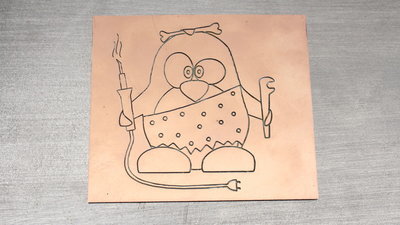
Engraving a copper plated board:
Feedrate: 80mm per infinitesimal
Dimensions of the graphics: 80x10mm
Depth: 0.6mm, 2 runs
If you tin can use this machine for creating curcuit boards? I will have a closer expect, shortly...
<<< CNC v3.2.two Next3D >>>
News The Project Technology RoboSpatium Contribute Field of study alphabetize Archives Download Responses Games Links Shopping tips Contact Imprint
Source: https://homofaciens.de/technics-machines-cnc-T8_en.htm
0 Response to "T8 Diy 3-axis Cnc Milling Machine W/arduino and Grbl Review"
Post a Comment